


Our Story
This Is Aura
Why Aura Surfaces exists, in my own words — Ashley Fabian
When I say I've been around the tile and surface industry for more than 30 years, I should explain what I mean — I'm 39, so I wasn't specifying porcelain at the age of nine.
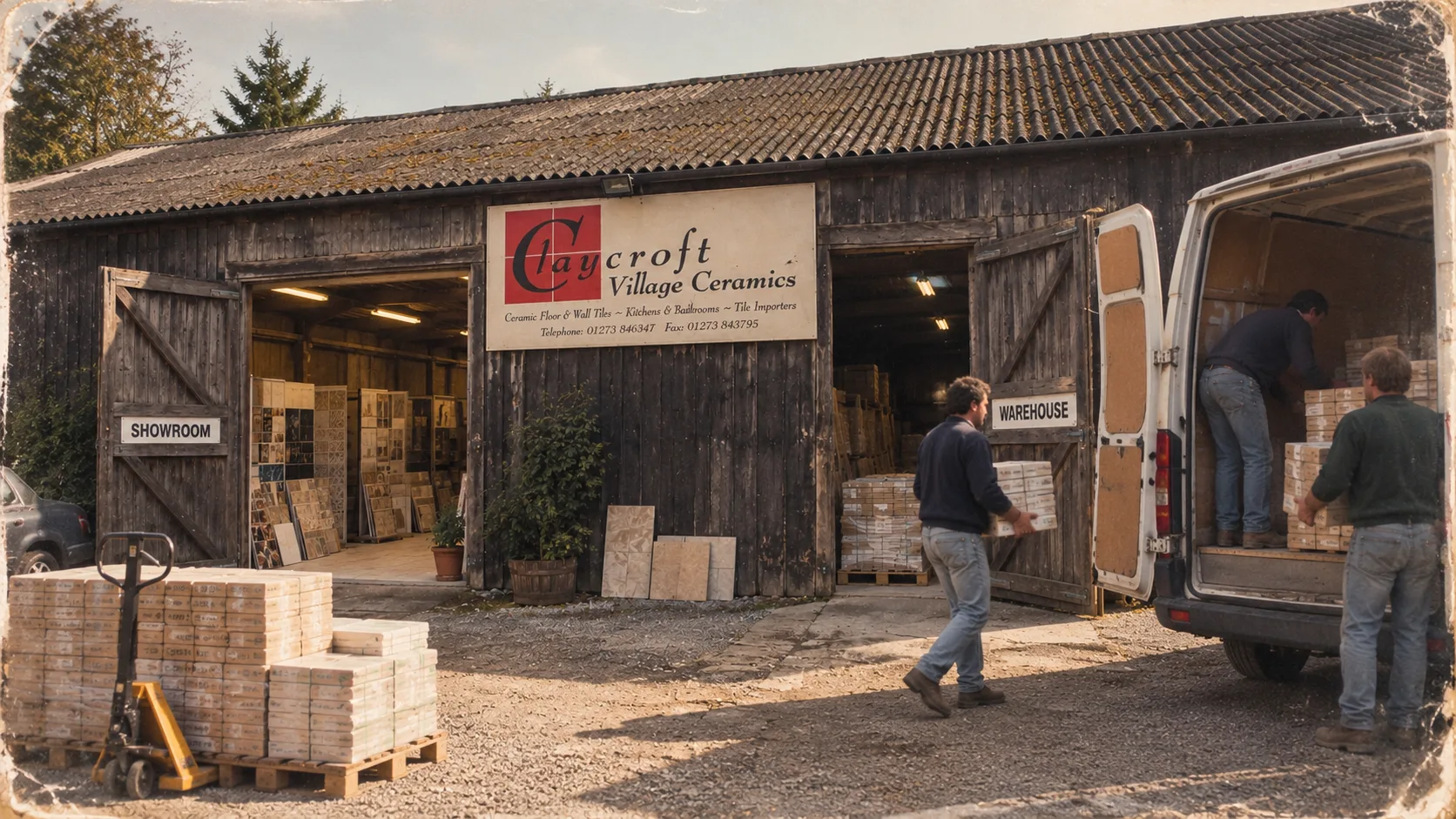
Illustrative recreation based on the original Claycroft Village Ceramics branding and family memories.
A shed on a vineyard: the start of a career in tiles
The truth is I've been around this industry for almost as long as I can remember. I was about six when my dad, Kevin, first got involved in tiles. He'd become unwell because of the trade he was in at the time, and a friend of his — who went on to become a bit of a legend in the tile industry — threw him a lifeline and helped him get started.
I can still picture the first premises: a shed on a local vineyard, nothing glamorous, pallets of tiny four-inch and six-inch tiles stacked around the place, matching soap dishes and towel rings designed to coordinate with them. I thought they looked incredible at the time. You'd wonder what we were all thinking now, but that was the industry then.
From that shed, my dad and his business partners built four retail stores across the South, supplying thousands of customers over the years — family bathrooms, kitchens, residential developments, commercial work, large private homes. My dad and the people he worked alongside became well respected in the industry.
So although I obviously wasn't working in tiles at six, I was absorbing the industry from a very young age. I didn't just see the industry as it is now — I watched it change completely.
I tiled my first showroom display at about ten. Not an award-winning installation, but I remember doing it. I worked in our Haywards Heath shop during school holidays and weekends, gradually going from getting under everyone's feet to being useful. I listened to conversations between my dad and customers, watched displays being built, watched how people chose things for their homes.
The surface industry gave my family a good life. Most importantly to me now, it gave me years working alongside my dad.
Plumbing, pools and cleaning equipment: learning the trade the hard way
Like most people who grow up around a family business, I didn't immediately want to spend my whole life doing exactly what my dad did.
From about sixteen until my early twenties, I went and did my own thing. I qualified as a plumber, worked on bathrooms, got into property renovations, and eventually moved into sales for a UK swimming pool and hot tub manufacturer. Even then I was still working around surfaces without really realising it — pools needed tiles and stone, bathrooms needed surfaces, I was meeting exactly the kind of homeowners and project clients I'd eventually build a career around.
That business didn't last — the director got carried away with the trappings of success, and it came apart. It taught me a lot: a business can look successful from the outside while being very different underneath.
From there I ended up selling cleaning equipment for one of the UK's largest Kärcher distributors. Glamorous, I know. The money was good, and I learned a lot, though not always what the company intended. It was numbers-driven and pushy — call more people, chase harder, hit the target. Some people are brilliant at selling that way. It never sat comfortably with me.
People do business with people. More specifically, people do business with people they like, trust, and believe actually care what happens after they've taken the order.
Coming back into the tile trade — and being humbled
Eventually I sat my old man down and told him I thought it was time to come into the family business properly. He welcomed me in, and I arrived full of confidence and ideas, convinced I was going to modernise everything these people had spent years successfully building.
That went about as well as you'd imagine.
I learned quickly that having ideas and understanding a business are two very different things. I stepped back, worked, listened and watched. I started learning the industry properly rather than assuming that growing up around it meant I already knew it — porcelain, ceramic, mosaics, natural stone, but also manufacturing, production, batches, shades, finishes, installation, logistics, and the quirks of different factories. Over time I built my own relationships with suppliers and manufacturers, rather than leaning on the ones that already existed.
How digital printing and large-format porcelain changed the tile industry
When I was a kid, a tile collection could be four colours, a matching floor tile, a decorative strip. If you wanted to be a tile retailer, you needed stock on the shelf.
Then digital printing changed everything. Manufacturing improved fast. Formats got bigger. Surface graphics became realistic enough to reproduce stone, marble, concrete and timber convincingly in porcelain. Collections grew from four colours and two sizes to fifteen or eighteen colours, ten formats, multiple finishes, matching mosaics, indoor and outdoor options.
I remember when we started stocking 600×600mm and 300×600mm tiles and people genuinely told us they were too big. Fitters didn't want to use them. Now we barely even call those large format.
Then we pushed bigger again — one of the earlier companies locally to import and display decorative large-format porcelain slabs around 1200×2400mm. I remember a competitor walking into our showroom and asking if he could bring his branch managers in, because they were nervous about large-format material.
The funny thing is, the stuff people laughed at then is completely normal now.
At the same time, the internet was transforming things. E-commerce opened the market completely. Products that once needed a drive around three or four showrooms could be searched for in seconds. Prices became instantly comparable, and everyone was fighting over the same customers with the same products — while, ironically, the products themselves were becoming more technically interesting than ever.
Why I closed a 30-year family tile business
That's difficult to say, because retail provided for our family for more than thirty years. But I found myself standing there with decades of experience, relationships with brilliant manufacturers, access to genuinely exciting products — spending too much of my day discussing whether someone could save £30 buying five square metres online.
I don't blame the customer for that. The problem was realising I didn't want that to be the conversation for the next twenty years. It wasn't the part of the industry I loved.
I loved the difficult projects. The person who walked in with an idea they couldn't quite explain. The architect who wanted a particular finish but couldn't find the material. Going back to manufacturers and asking, “Can we do this?” Working out how an internal surface could continue outside, how to fabricate a staircase, how to solve an awkward pool detail, how to find an alternative when something had been discontinued.
Over the last few years we've watched a lot of independent retailers disappear — businesses that had served their communities for decades, unable to make the traditional model work any more. If I hadn't made what felt at the time like a pretty rash and frightening decision to close the business that had supported our family for over thirty years, I genuinely think we could have become one of them.
Building Aura Surfaces: a surface consultancy for architects and designers
Aura Surfaces was being built in my head for years before we ever registered the company. So I spent around eighteen months listening and learning again — speaking to architects and designers, looking at how they sourced materials and what frustrated them, travelling, visiting manufacturers, building new relationships.
And, importantly, I stopped thinking solely about tiles. If someone is designing an extraordinary home, hotel, restaurant or leisure project, they're not thinking in separate boxes — a tile shop, then a timber flooring shop, then somewhere else for stone. They're trying to create a space.
We don't want to begin every conversation by asking what tile someone wants. I'd rather ask what they're trying to create.
Sometimes clients arrive with a detailed specification. Sometimes it's a Pinterest board, a photo of a hotel from six years ago, and no idea what the material was. Both are fine. Our job is to understand what they're trying to create and then work backwards from there, using our knowledge and the relationships we've built to find the right material — porcelain from a major Italian or Spanish manufacturer, natural stone from a quarry, handmade decorative concrete from Portugal, engineered timber, terrazzo, architectural slabs, or something I've found by going too far down a product rabbit hole.
Independence gives Aura an advantage here. We're not tied to selling a particular factory because we've got three containers of its stock in a warehouse. We look at the project first, and decide what material makes sense afterwards.
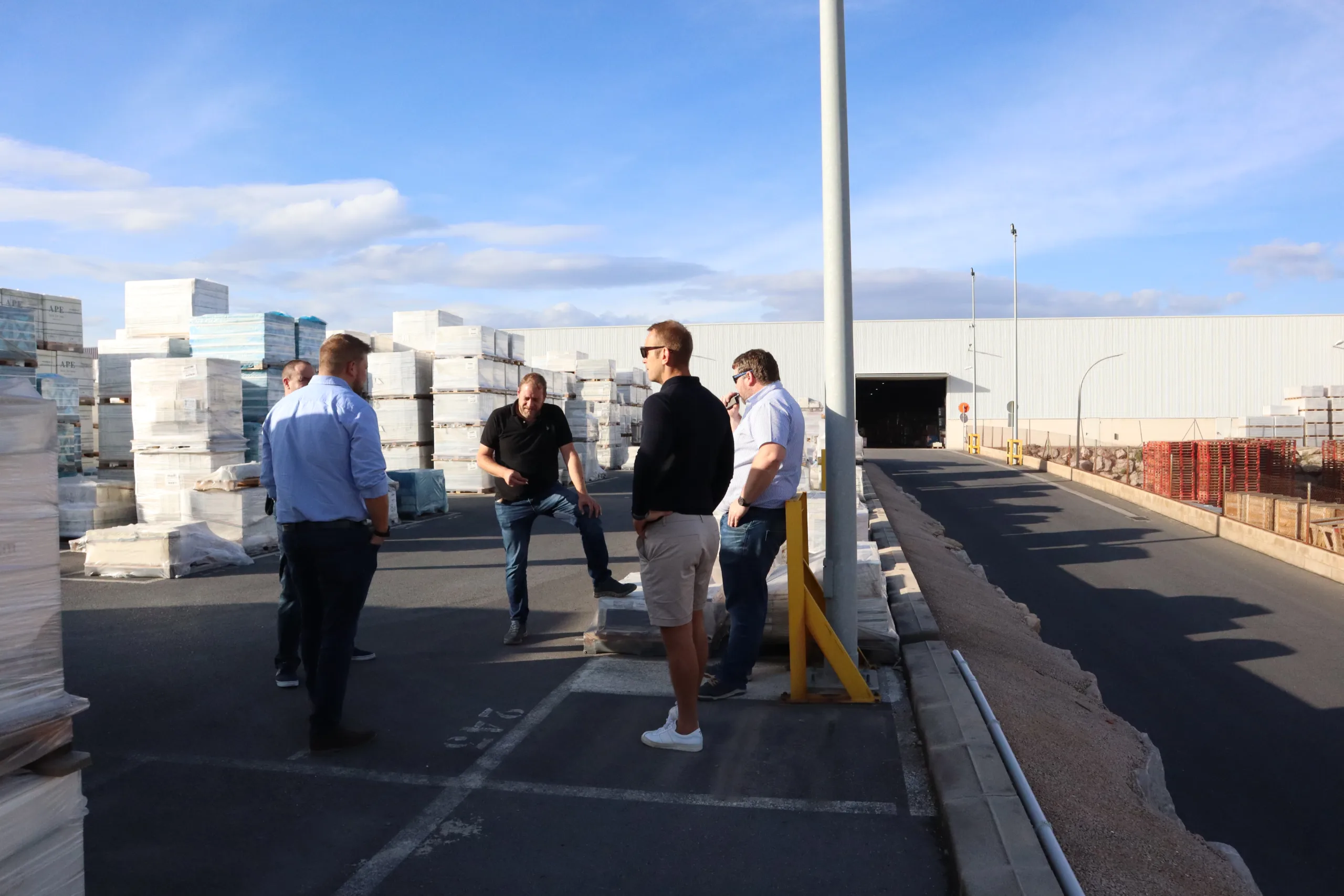
Featured projects: porcelain and stone specification
Finding something beautiful is only half the job. It doesn't matter how amazing a sample looks if it's wrong for where it's going. Is it internal or external? Around a pool? What slip resistance does it need? Can the design continue outside in 20mm? Can it be fabricated for stair treads? What happens when someone wants another 200 square metres twelve months later? How do you get 1,500 square metres safely onto a site that isn't ready for all of it at once? Those are the parts the finished photographs don't show.
Shards, Cuckfield — 1,500m² of porcelain across an award-winning home
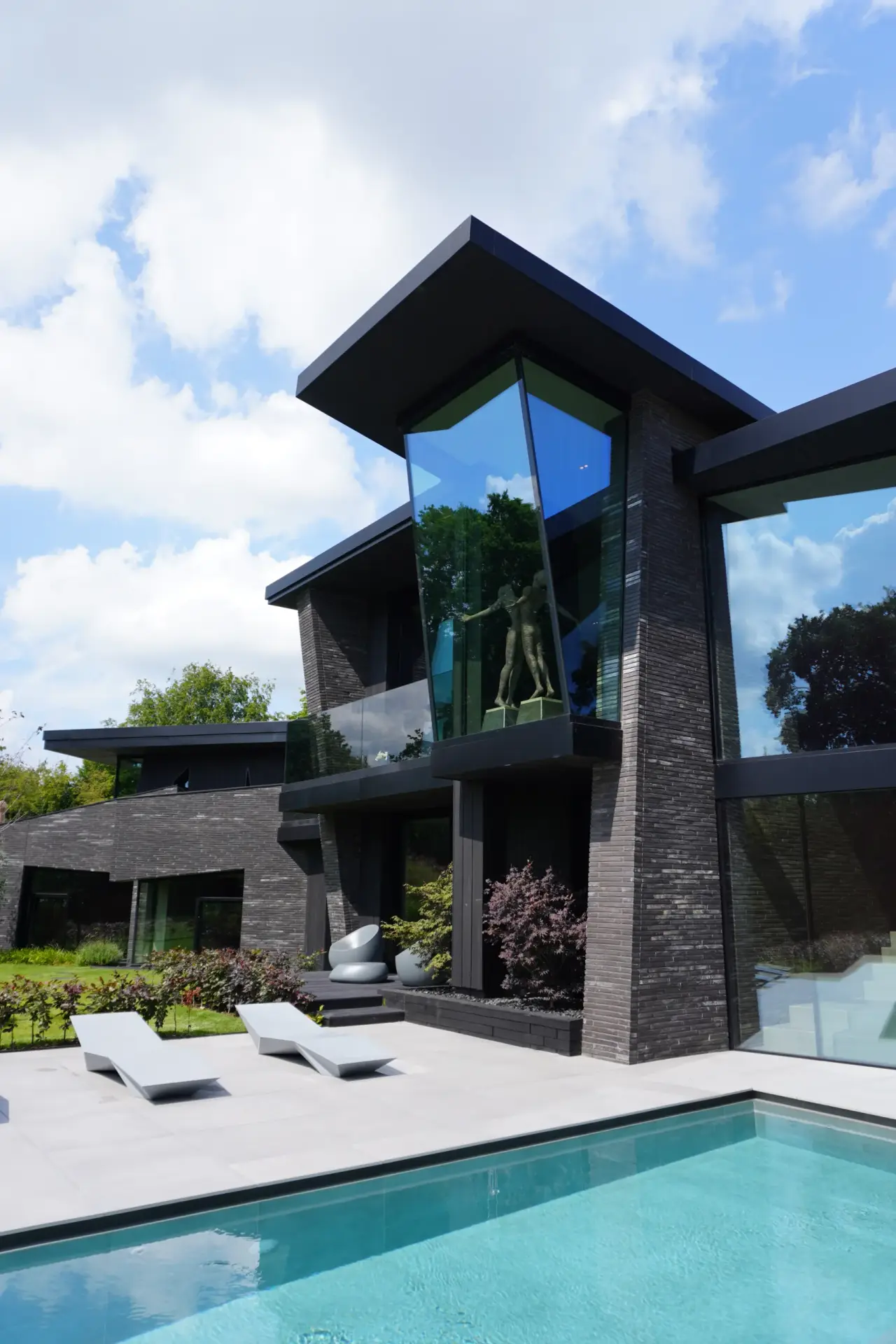
The client came to us when the house was barely a building at all. It took more than a year of samples, conversations and changes before we settled on Mirage Clay. That one collection eventually spread through almost the entire property — more than 1,500 square metres across the main floors, bathrooms, bedrooms, gym, sauna, staircase, balconies, patios and pool areas. We held stock in our warehouse, delivered in stages by HIAB as the project manager needed it, and worked to maintain batches as extra quantities were added later. The project went on to win awards. The better measure, for me, is that the client is using us again.
A private residence in Battle, East Sussex — specifying to a budget without compromising the result

Six bathrooms, a huge area of 1200×1200 polished porcelain downstairs, fabricated staircases, a bookmatched master ensuite, steam showers, around 500 square metres of exterior paving. Exceptional taste, big ambitions — and still a budget. Part of our role was deciding where that budget actually mattered: spend more in the master ensuite to create the statement he wanted, then find equally attractive, more commercially sensible materials for the secondary bathrooms. Good specification isn't about selling the most expensive thing you can find. Sometimes it's knowing when not to.
Wise Home, rural Sussex — surfaces built to survive a real family
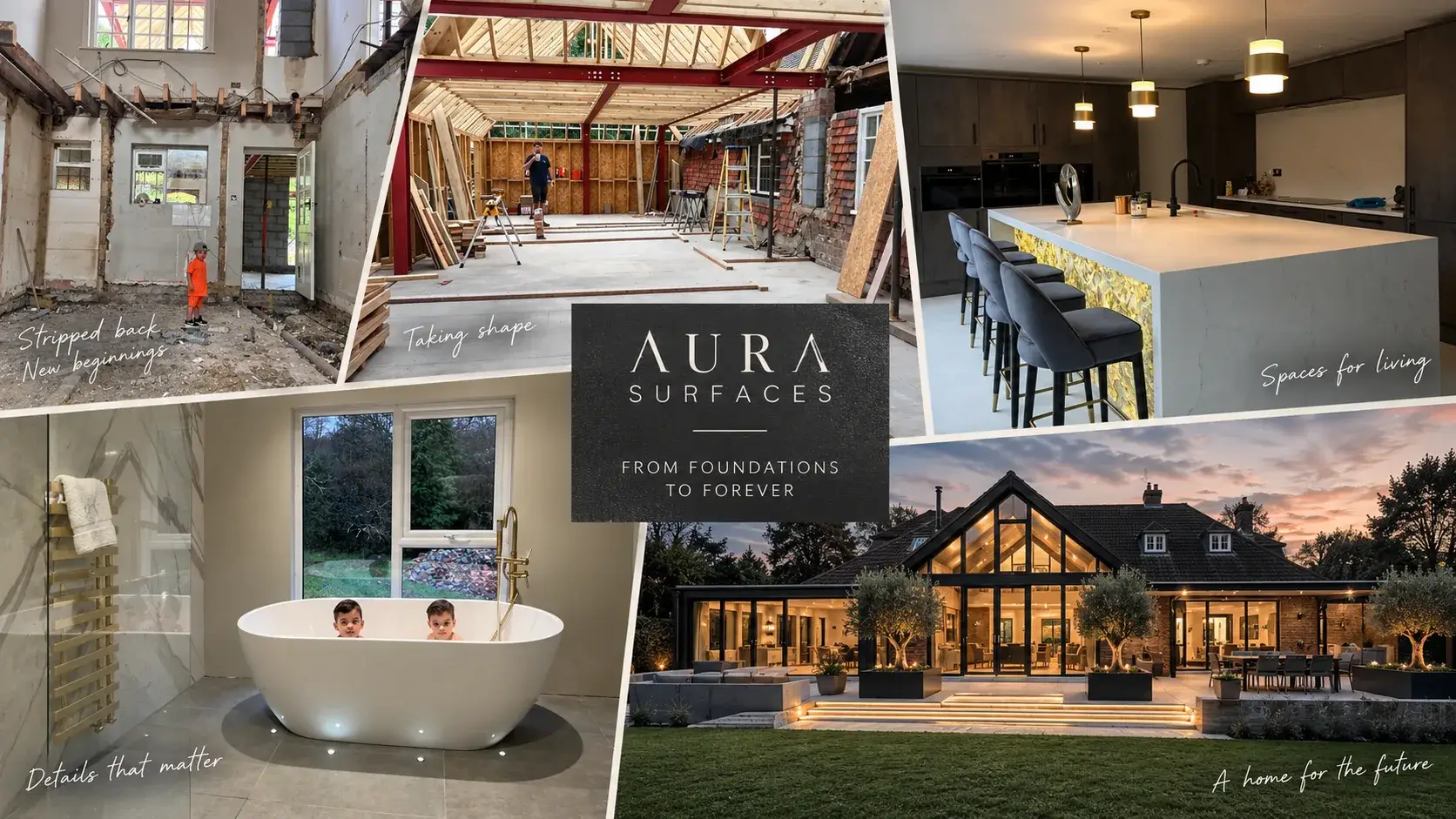
We got involved when the property was basically a shell — no proper ceilings, no staircase, walls missing. It's now a beautiful home, but also a real family home: two young boys, a large dog, social events, businesses run from parts of the property. The surfaces had to look amazing and survive actual life. When the exterior material we'd planned to continue from the inside was discontinued, we found a different collection that matched so closely most people would never know it wasn't the original plan. We've since supplied material for Hannah's clinic, studio and outdoor entertaining areas — and somewhere along the way, she and her family stopped being clients and became friends.
Aydo Lounge, Brighton Marina — commercial porcelain specification for a working restaurant

A beautiful scheme, a client investing hundreds of thousands into the fit-out — but the materials still had to fit a budget and actually work in a busy restaurant. A polished natural marble might look incredible in a concept image, but if it's difficult to maintain or unsuitable underfoot, we haven't done our job. We found a porcelain that delivered the depth, veining and character the client wanted, with something far more appropriate for a commercial hospitality environment.
For me, experience isn't about knowing a thousand product codes off the top of your head. It's about understanding what the person in front of you actually needs and knowing where to go to find it.
Family, loss, and why relationships matter more than transactions
For me, business has always come back to relationships rather than transactions. That idea was reinforced even more in October 2025, when I suddenly lost my dad.
The reason I can sit here and talk confidently about this industry is because of him. He gave me the opportunity to grow up around it. He gave me a job when I came back thinking I knew everything. He let me make mistakes, argued with me when he thought I was wrong, and supported me when I wanted to try something different. There are things happening with Aura now that I wish I could ring him and tell him about.
Having children of my own has made me look at that differently too. My kids have grown up with me talking about tiles, projects, factories and whatever problem is occupying my brain that week, just as I grew up around my dad's business. I'm not suggesting they need to follow me into it. But I'd like them to look at Aura one day and understand that we took something the generation before us created, and tried to move it forward rather than simply preserve it.
It isn't rejecting where I've come from. It's the opposite — respecting what my dad's generation built enough to make sure it continues to evolve.
Where Aura Surfaces is going next
We're still a young company. We've made mistakes, and I'm still learning every day. But I don't want Aura to become a company that thinks it has all the answers. I want us travelling, visiting manufacturers, looking at new technology and strange new materials. I want someone to send me something they've been trying to source for six months and say nobody can find it — because that's exactly the sort of thing that will keep me awake until I've worked it out.
There are exciting things happening for Aura right now — relationships on projects much larger than anything I imagined when we first incorporated the company, working internationally, talking to manufacturers and design teams in different parts of the world. But I don't want growth to remove the thing that made Aura worth creating. I don't want someone to become an account number. I don't want us to stop answering the phone because we've become too important. And I don't want to lose the curiosity that made me start searching for a different way of doing this in the first place.
I started this story with a shed on a vineyard, little four-inch tiles and matching soap dishes. Thirty-something years later I'm standing in factories looking at porcelain slabs several metres long, walking through quarries, working on award-winning houses, and talking to design teams about projects in places my dad and I probably wouldn't have imagined back then.
The products, the industry and the way people buy have all changed beyond recognition since I first started hanging around those showrooms as a kid, and Aura will keep changing with them. What I don't think needs to change is how we treat people: know your products, know your industry, stay curious, do what you say you're going to do, and when something goes wrong, own it and sort it out. Build relationships that last longer than the invoice.
We happen to do it through some of the most incredible surfaces being produced anywhere in the world. And after spending almost my entire life around this industry, I genuinely feel like we're only just getting started.
If you're working on something interesting and think we might be able to help, I'd love to hear about it.
Book Your Private Consultation